Custom web applications for processes off-the-shelf software cannot handle.
When internal workflows are spread across Excel, email, several programs and manual in-between steps, unnecessary complexity builds up. A custom web application brings these workflows together in one central system and maps exactly the business logic your company needs.
A custom web application is software built for the processes of one specific company, running in the browser with nothing to install. It maps the process the way it actually runs in the business instead of forcing it into the structure of an off-the-shelf product.
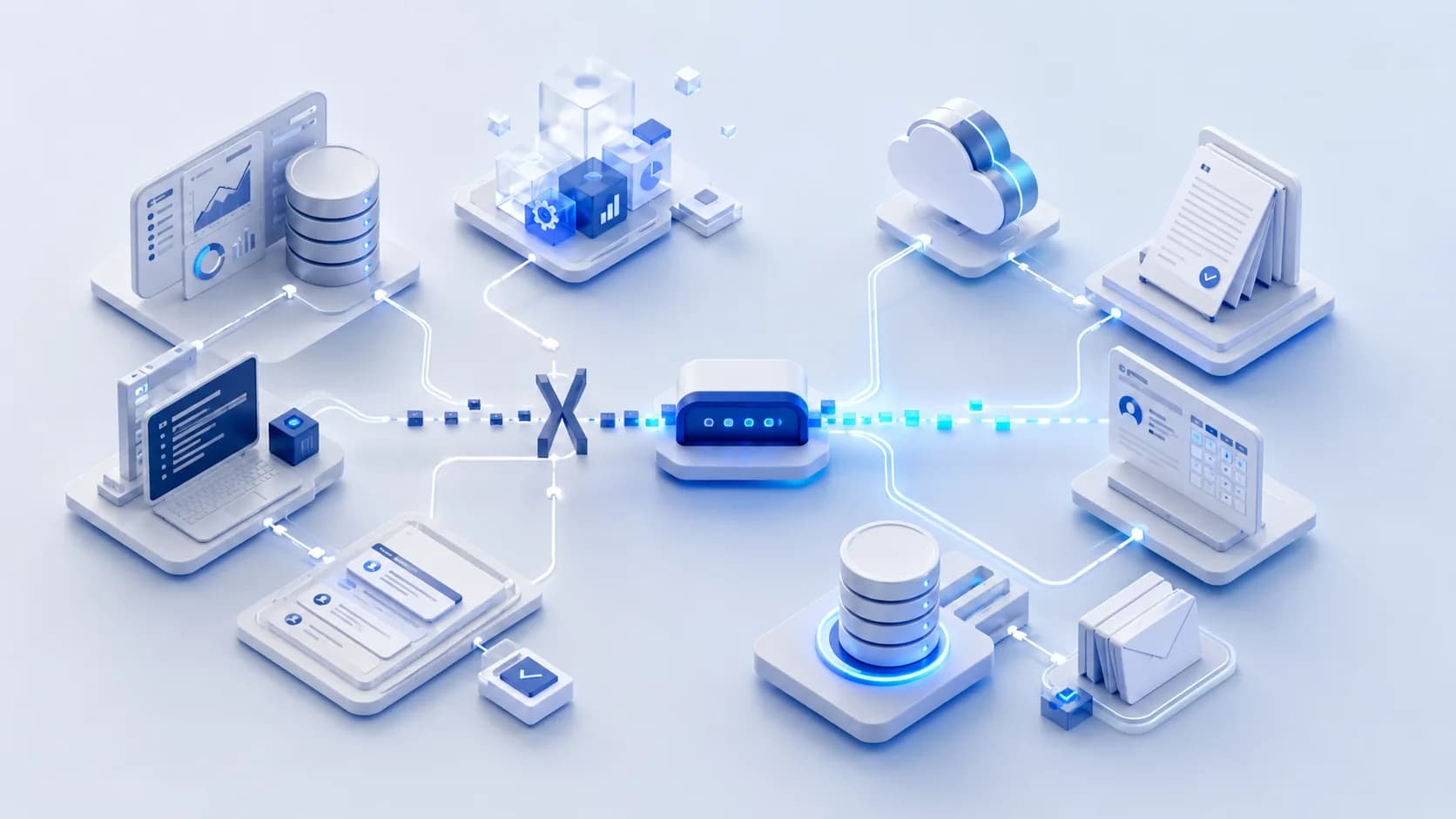 AI-generated
When the process is more complex than the software.
Many companies already work digitally — just not end to end. Customer data lives in the CRM, orders in the ERP, additional information in Excel, and individual processing steps are coordinated by email or in person.
As long as volumes stay small, this works. As customers, employees or cases grow, duplicate data entry, follow-up questions, errors and missing transparency creep in. That is the point where it pays off to stop organising the workflow around the software — and instead build a web application that follows the process.
What scattered workflows really cost.
Scattered workflows rarely fail loudly. They cost in small increments: a follow-up question here, a spreadsheet maintained twice there, a case whose status nobody knows for certain. Added up, this ties managers and employees into coordination a system could handle.
- Data is entered twice in several systems
- The current status of a case is not visible
- Errors appear when copying between Excel and software
- Process knowledge depends on individual employees
- Reports have to be compiled by hand
One central system that maps your business logic.
A custom web application brings data, workflows and responsibilities together in one system: with its own database, roles and permissions, digital approvals and exactly the workflows your company actually needs.
The application runs in the browser, needs no installation and is available to every employee — in the office, at home or on the road. New users, locations or process variants can be added without rethinking the application.
What we solve with it.
Less coordination. More clarity.
Custom web applications create one central place for processes, data and responsibilities. It becomes clear which case has which status, who is responsible and which information is needed next.
- Less manual work
- Fewer sources of error
- Clearer responsibilities
- Better reporting
- Faster processing
- Central data
- Scalable workflows
 Unsplash
Standard software or a custom web application?
Standard software makes sense when the process is standardised — nobody needs to reinvent accounting, payroll or email. Custom software development becomes interesting when the process itself is what sets you apart:
- The company has specific workflows no standard product knows
- Several systems have to be connected into one continuous process
- Existing tools create too many workarounds and extra spreadsheets
- The business logic is a competitive advantage
- Processes should not be changed just to fit a tool
Existing systems stay in use.
A custom web application does not automatically replace what works. It connects to ERP, CRM, databases or specialist software through interfaces and closes exactly the gap that Excel and email bridge today. Data is captured once and available in every connected system.
From process to application.
Every project starts with the process, not with a specification document: we analyse how your company works today, translate the workflow into a data model, roles and workflows, and then build the application in verifiable steps. After launch we keep operating, monitoring and extending the system.
oneeonee builds custom software for companies in the Stuttgart and Ludwigsburg region and across the DACH market — on site, remote or combined.
Technology that has proven itself.
Technically we build on a modern, durable stack — including Next.js, React, TypeScript, Node.js and PostgreSQL. What matters is not the tool, but that the application carries your process reliably and stays extensible for years.
Related building blocks
A custom web application can be connected to your ERP or CRM through integrations, extended with automation, and built on a clean data foundation.
Frequently asked questions
When is custom software worth it?
Custom software becomes interesting when core business processes can only be handled with workarounds, extra spreadsheets or manual steps in standard software. At that point the gap between process and software costs time every day — and a tailored solution pays for itself through saved work and avoided errors.
Can we keep using our existing software?
Yes. Custom applications can be connected to ERP, CRM, database or other existing systems through interfaces. We only replace what genuinely no longer carries its weight — everything else stays in use.
What does a custom web application cost?
Costs depend on process scope, integrations, user roles and requirements. oneeonee works per project and estimates the effort after an initial analysis — a substantiated assessment instead of a flat rate.
Can the software be extended later?
Yes. The architecture is designed from the start so that new functions, user groups and integrations can be added. The application grows with the company instead of limiting it.
How long does development take?
It depends on the scope. We develop iteratively: a first production-ready version covers the core process and is often in use after a few months — further functions follow in verifiable steps while the system is already working.
Your process does not fit standard software?
Then we should not force it into one. Show us how your business works today and where the process starts to break down.