Your systems work. Just not with each other.
Many companies already own capable software. The real problem lives between the systems: data has to be exported, copied, re-entered or passed on manually. These are exactly the gaps we close with custom integrations.
An interface is an automatic connection between two systems that transfers data by fixed rules, with no human retyping it. An integration uses this to connect ERP, CRM and specialist software so every piece of information is maintained in one place only.
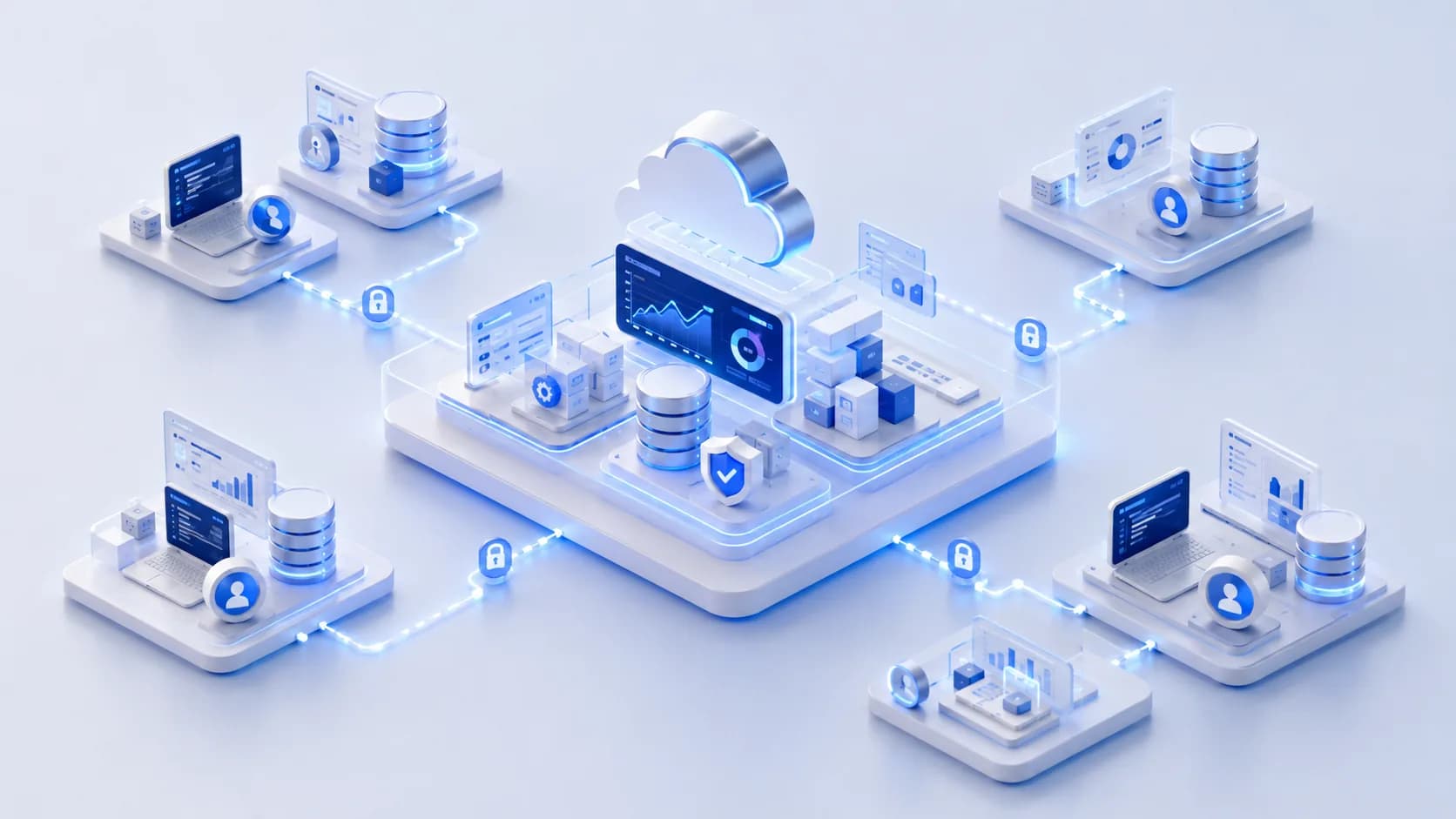 AI-generated
One order, four systems, many manual steps.
A typical example: an order is created in the CRM, then transferred into the ERP by hand, documents are generated separately and the processing status is communicated by email.
Every single step works. The overall process still does not — because between the systems, people copy, export and re-enter what already exists digitally.
The gap between the systems.
Media breaks are expensive: every manual transfer costs time, produces errors and lets data states drift apart. With every additional system and employee, the coordination effort grows — and the system landscape that was supposed to help starts generating administration.
Custom integrations close the gap.
We connect your systems through custom interfaces and APIs so information flows automatically to where it is needed — reliably, traceably and, where necessary, in both directions.
What integrations make possible.
Capture data once. Use it correctly everywhere.
System integration means: a case is created once and is current everywhere. That speeds up processes, lowers error rates and makes growth possible without administration growing with it.
- No duplicate data entry
- Fewer transfer errors
- Current data in every system
- Faster processes
- Fewer media breaks
- Better scalability
 Unsplash
Respect for what exists.
Integration does not mean rebuilding your existing systems. In most cases ERP, CRM and specialist software stay untouched — we use their existing APIs, database access or import and export options and build the connection around them. Even systems without an official API can often be connected.
First the map, then the connection.
We start with a look at the system landscape: which applications exist, which data flows where, what is transferred manually today? From this we derive an integration concept with clear priorities — implemented step by step, starting with the connection that relieves the most.
How we connect systems technically.
Depending on the system we work with REST APIs or GraphQL, with webhooks for real-time events, with OAuth for secure authentication, with direct database integration or with import and export routes. Where several systems need coordinating, a lean middleware or custom connector is built — documented, monitorable and maintainable.
Related building blocks
Integrations deliver the most value together with automation — and they are the foundation on which custom web applications cooperate with your existing landscape.
Frequently asked questions
Our software has no official API — is it still possible?
Often, yes. Besides official APIs there are usually other routes: direct database access, import and export files or monitored exchange folders. What is possible and sensible in your case is part of the analysis.
Does our existing system have to be modified?
Usually not. The integration is built around the existing systems and uses their existing capabilities. We deliberately avoid modifying third-party software.
What happens when one of the systems gets an update?
Integrations are monitored and maintained. If an update changes a system's behaviour, monitoring catches it and it gets fixed before the process is disturbed — one reason we keep supporting integrations after launch.
Is real-time synchronisation possible?
Depending on the system: where webhooks or events are available, data flows within seconds. Where they are not, we work with short polling intervals — for most business processes both are more than fast enough.
How long does an integration take?
A single connection with a clear scope is often in production within a few weeks. Complex integration concepts spanning several systems are implemented step by step — every finished connection already relieves the team while the next one is built.
Your process does not fit standard software?
Then we should not force it into one. Show us how your business works today and where the process starts to break down.